Nanophotonics
Nanostructured materials offer unique opportunities for controlling light at subwavelengths. We are pursuing an active research program using nanophotonic systems to tailor light-matter interactions and create devices with novel properties.

Quantum Gases, Quantum Information
and Correlated Many-Body Systems
The Experimental Quantum Physics group is engaged in the study of quantum phenomena and the development of quantum technologies. For this purpose, ultracold atoms at temperatures of a few billionths of a degree above absolute zero are used to simulate strongly correlated states of matter from solid state physics. Furthermore, the group investigates entangled states of light and matter in optical microresonators.
Atomic-scale dynamics of quantum materials
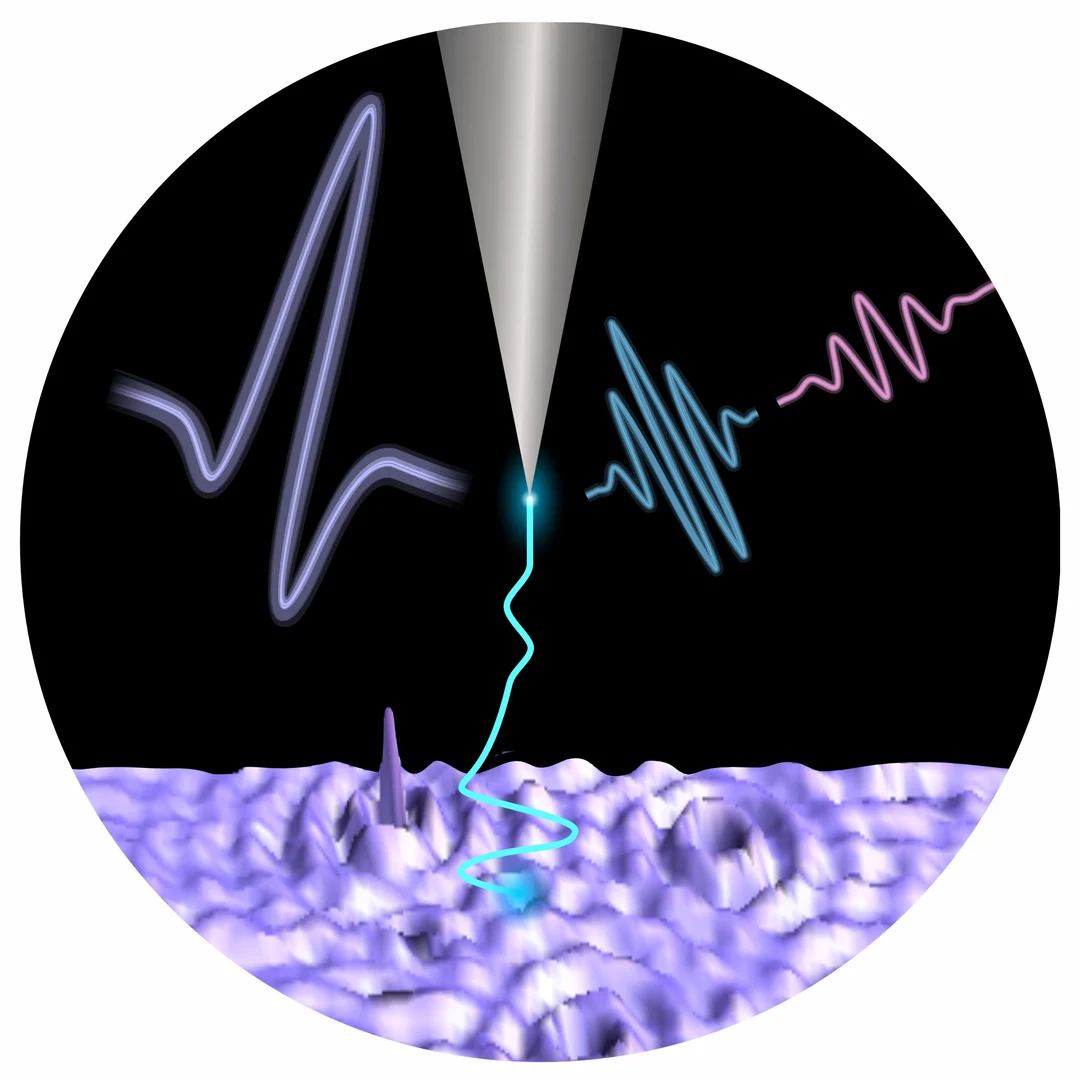
We use advanced scanning probe microscopy combined with cutting-edge laser technology to study the non-equilibrium behaviour of solid-state quantum states such as charge density waves, topologically non-trivial states, or excitonic quasiparticles in 2D materials. One of our major goals is to image the dynamics and evolution of such states on their natural time and length scales with simultaneous femtosecond temporal and sub-nanometer spatial resolution. Our experimental toolbox comprises broadband THz-lightwave-driven scanning tunneling microscopy (THz-STM), femtosecond optical excitation and photon-assisted STM, as well as STM-induced luminescence and advanced near-field techniques in extremely localized optical fields. For more information, see our highlights and research topics.

Quantum Metrology
"Quantum metrology": this is the art of measurement using phenomena of quantum physics. Specifically, we aim to increase measurement sensitivity beyond what would be possible in classical systems, and we do this in an interdisciplinary approach. We cover a broad range of topics, from very fundamental questions ("Why is there so little antimatter in the universe?") to the development of devices that are close to applications (such as photonic modules for future quantum communications). And as we all know, optical clocks are by far the most precise measuring instruments we can imagine, which is why we are making some efforts to improve them further.

Ultracold gases and
Quantum Many Particle Systems
The research of the group is in the field of theoretical quantum physics. We are interested in complex phenomena that arise from the interaction of many particles. Experimental realizations of such complex quantum systems include ultracold atomic gases, hybrid atom-light systems, and quantum materials. Our research tries to overcome the challenges of the theoretical description of such quantum many-particle systems, their fascinating quantum phases and their collective phenomena by numerical and analytical methods.

Nanoscopic and Strongly Correlated Electron Systems
and Photonics
Coming soon
Condensed matter and Quantum Optical Systems
Research focuses on many-particle quantum mechanics, which leads to many fascinating phenomena in condensed matter and optical quantum systems, such as superconductivity, magnetism, and entanglement. Special interest is given to dynamical phenomena far from thermodynamic equilibrium, such as time crystals or many-particle localization. The development of digital quantum computers marks the beginning of a new era for true quantum simulation of these systems, and active work is being done towards this goal.