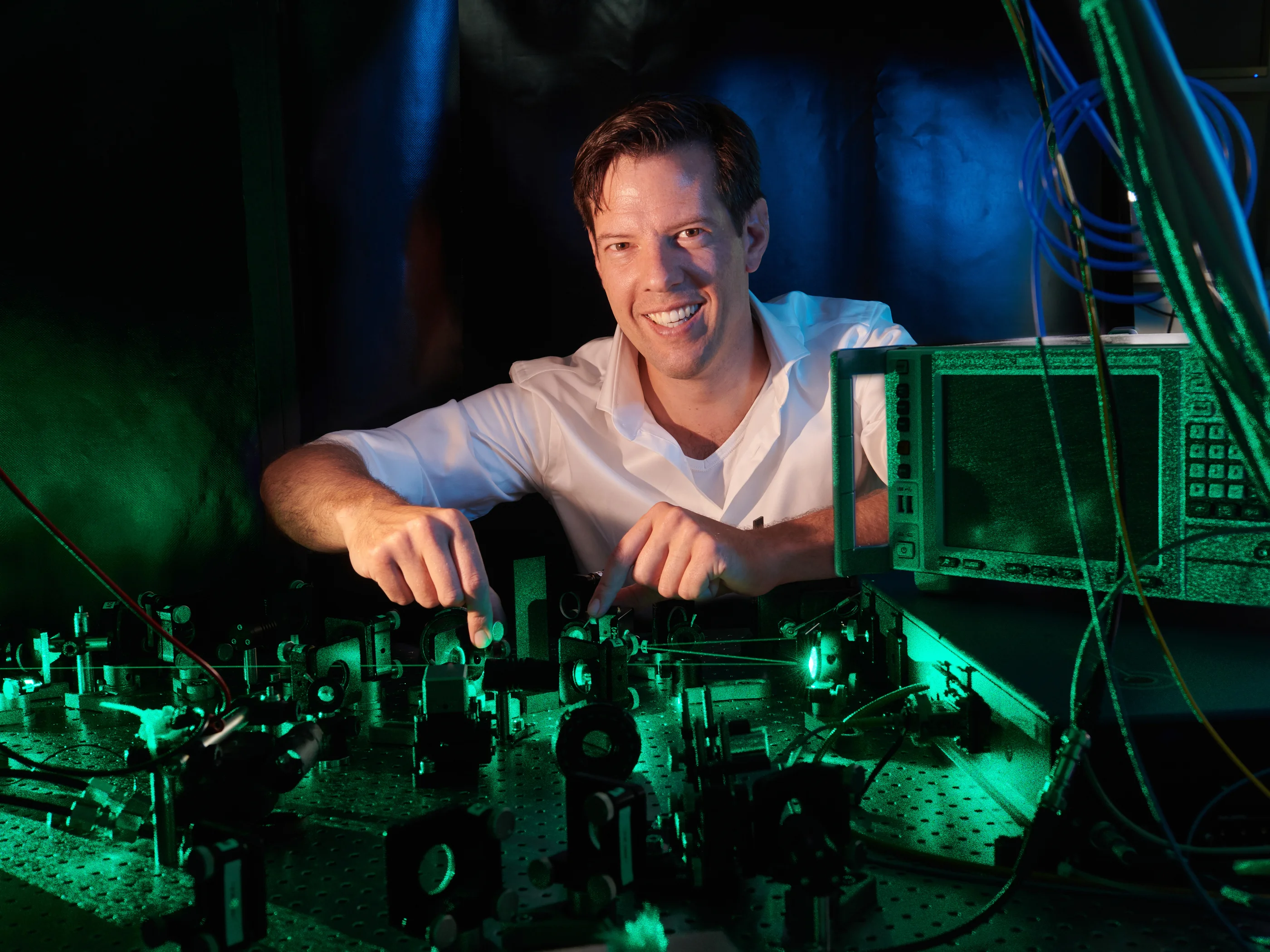
Welcome to the webpage of the research group of Prof. Dr. Simon Stellmer.
"Quantum metrology": that's the art of measuring using phenomena from quantum physics. Specifically, we aim to increase measurement sensitivity beyond of what would be possible in classical systems, and we do this in an interdisciplinary approach.
Latest News
We continue to establish zinc as a candidate for optical clocks, quantum information processing and BSM physics: Felix looked into the isotope shifts and hyperfine splittings of the 308-nm intercombination line, which is relevant for second-stage cooling and linked to the "real" clock transition. This work has now been published with PRA, link: https://journals.aps.org/pra/abstract/10.1103/51f6-894b
Over a series of Bachelor's and Master's theses, we set up an array of ring laser gyroscopes to reconstruct the 3D rotation vector. Such a sensor, transportable and scalable, will find applications in seismology. The design and the first characterization is not available with the journal Measurement Science and Technology, link: https://iopscience.iop.org/article/10.1088/1361-6501/ae7994
The invention and further development of lasers has opened up entirely new and vast areas in both science and technology. The operation of optical clocks, as well as many approaches to quantum computing, would not be possible without the development of narrow-linewidth lasers in the blue und UV part of the spectrum. Pushing narrowband cw lasers ever further into the UV is an exquisite challenge that will enable the adressing of atoms (think of laser cooling hydrogen), molecules (most diatomic molecules with double bonds have strong transitions around and below 200 nm) and nuclei (148-nm transition in Th-229). Development of such lasers between 120 and 200 nm is now supported by BMFTR within the new project VUV-goes-Quantum that will start in July.
We have a new SHK in our group: Keno Hein, currently in his 4th bachelor semester, will join the ring laser team to work on the pointing stabilization of large rings. Welcome to the group!
Sensing rotations at insane sensitivities in the 0.1 prad/s range (that's one full revolution in 100.000 years) is currently a hot topic, with two concepts battling for the lowest sensitivities and instabilities: active and passive ring laser gyroscopes. One particular application is in the field of seismology, where the reconstruction of the three-dimensional rotation component of the wave field adds a wealth of information for the conventional measurement of linear accelerations. Here, Thomas has constructed and characterized the world's first three-dimensional passive ring laser gyroscopes, already in design that is transportable and allows for operation in remote locations. This work is published with Measurement Science and Technology and can also be found on the arXiv here.
In preparation of second-stage laser cooling in zinc, we have, for the first time, performed Doppler-free spectroscopy on the 308-nm intercombination line. This transition has a linewidth of about 5 kHz and is ideally suited to laser cooling to micro-Kelvin temperatures. Felix used Doppler-free laser-induced fluorescence to nail down isotope shifts and hyperfine splittings to below the few-kHz linewidth. The manuscript can be found here.
Simon Stellmer has been awarded a prestigeous Erskine Fellowship by the University of Canterbury in Christchurch, New Zealand. He will spend part of his sabbatical in the winter term 2026/27 in Christchurch to work on the C-II ring laser, the world's only monolithic ring laser that can be operated in both active and passive mode.