


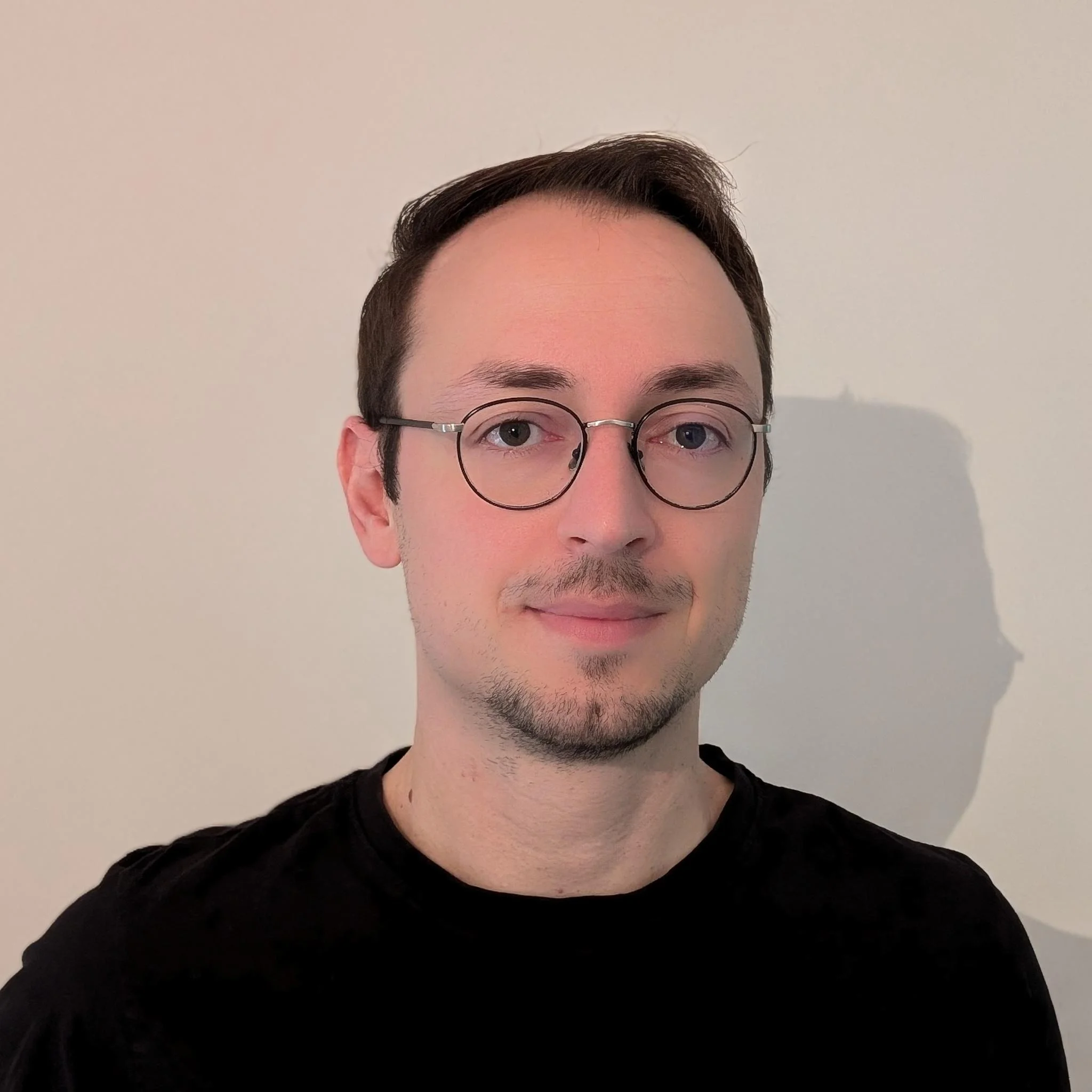
Dr. Markus Prim
Our group explores the physics of B mesons — particles that offer a unique window into the fundamental forces of nature. By studying their hadronic and semileptonic decays, we aim to answer three key questions:
- What is the true value of the CKM matrix element Vcb?
- Are interactions with the three lepton generations truly universal, as predicted by the Standard Model?
- And how does the strong force (QCD) shape these precise measurements?
To tackle these questions, we work with the Belle and Belle II experiments in Japan, which produce enormous numbers of B mesons in an exceptionally clean experimental environment. Together, these studies bring us closer to understanding the fundamental symmetries of the universe.

Here are a few topics I am interested in and that my group is working on.
Unravelling the D**
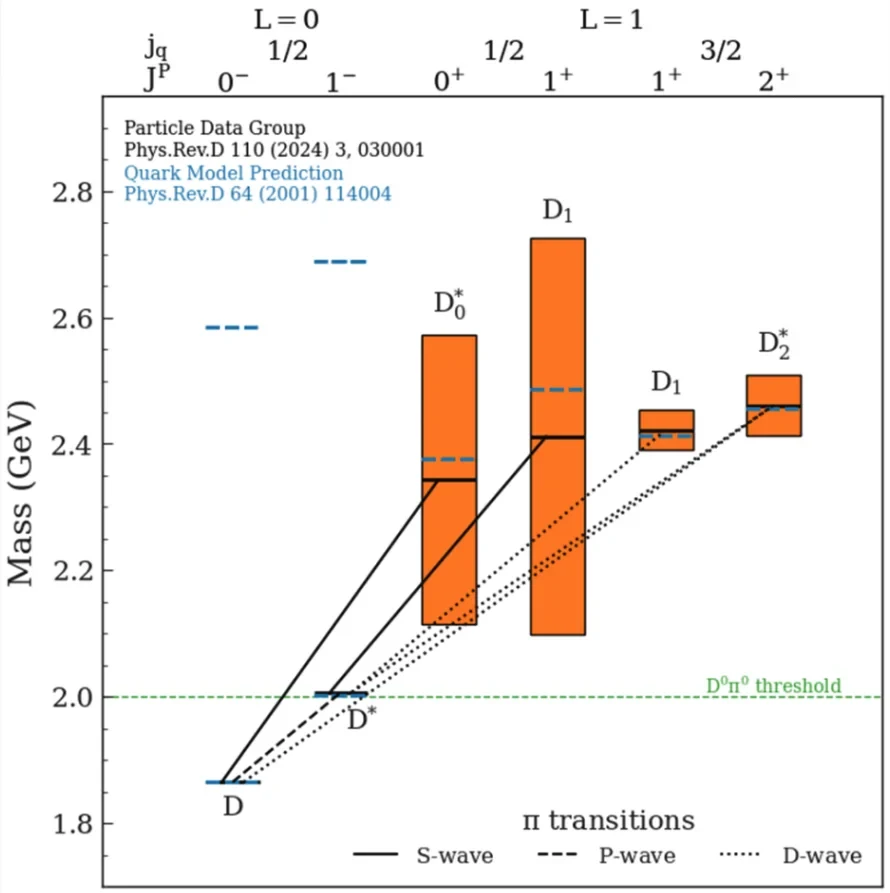
In the quark model, mesons are composed of a quark and an antiquark whose masses and quantum numbers arise from their internal spin and orbital configurations. The ground-state charmed mesons (D and D*) correspond to zero orbital angular momentum, while the orbitally excited states, collectively called D**, have L=1 and a more intricate structure. These excited states include several overlapping resonances that are difficult to model and measure precisely. Their complex behavior plays an important role in semileptonic B-meson decays, where uncertainties in the D** sector can affect the extraction of the CKM parameter |Vcb| and the tests of lepton flavor universality in R(D) and R(D*). Understanding the D** system is therefore essential for improving the precision of key Standard Model measurements.
Inclusive and Exclusive Vcb
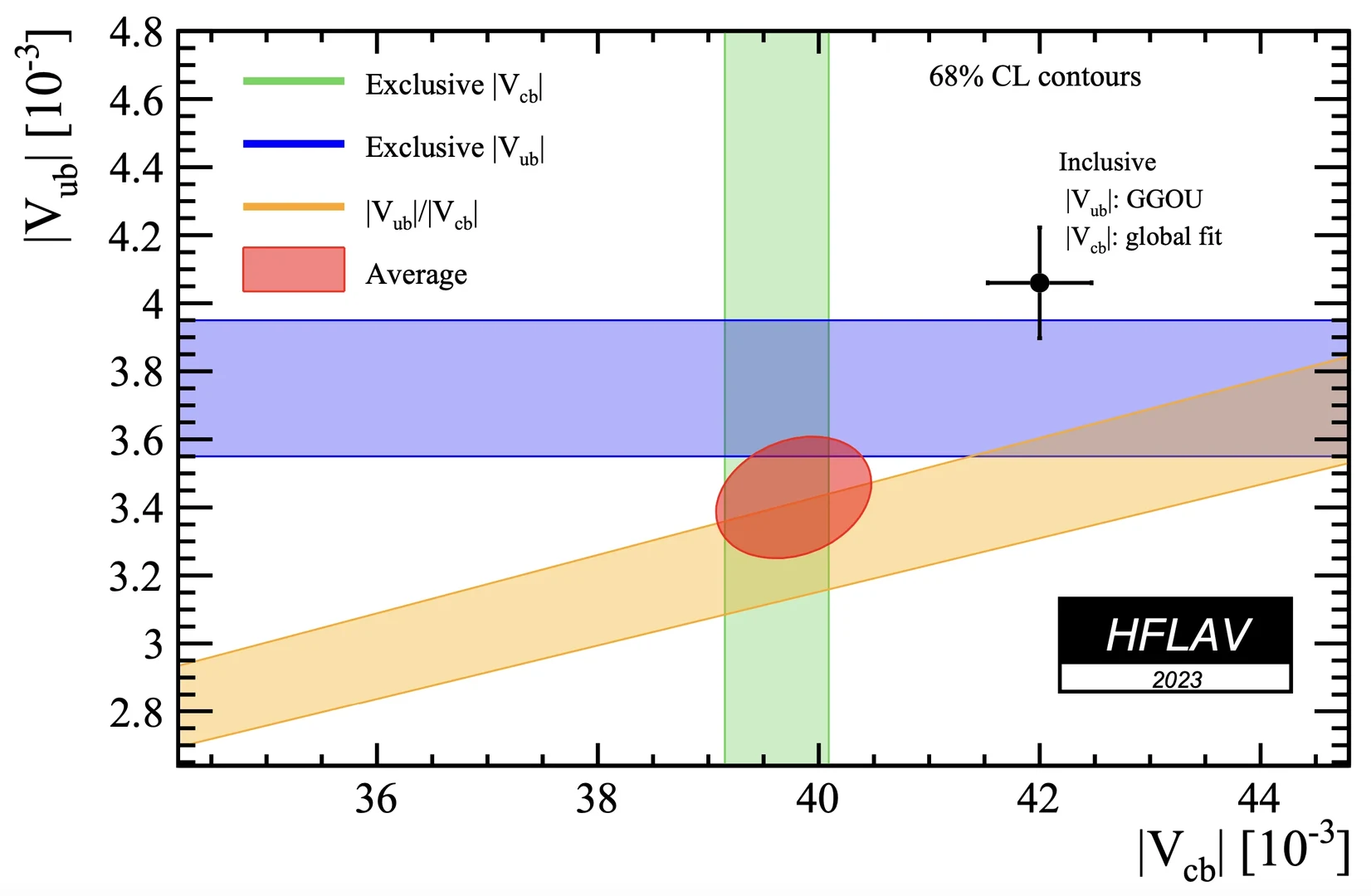
In the Standard Model, the Cabibbo-Kobayashi-Maskawa (CKM) matrix is the only source of charge-paritiy violating interactions. Such are needed to explain the matter dominance of today's universe and are only possible if matter and antimatter exhibit different properties. Our group is world leading in the determination of the CKM matrix elements Vub and Vcb, whose size describe the coupling strength of the weak interaction between beauty and charm or beauty and up quarks. The ratio of |Vub|/|Vcb| directly constrains the allowed amount of of matter-antimatter asymmetry. Intriguingly different methods lead to different amounts! We are on the forefront to explore and substantiate these differences, to develop a better understanding of the matter-antimatter symmetry breaking meachnisms of the quark sector.
Lepton Flavor Universality
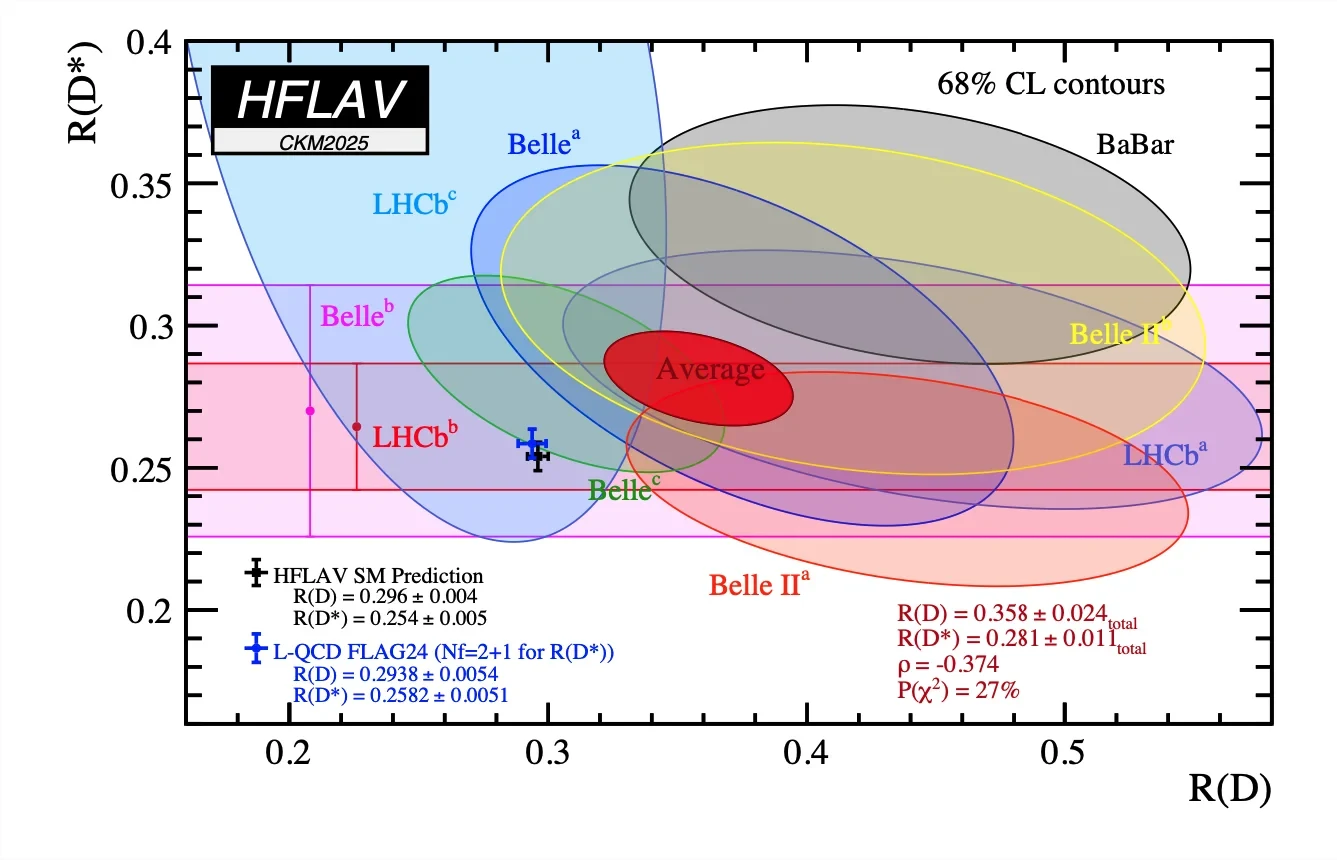
In the Standard Model of Particle Physics there are three flavor generations of leptons and quarks. Particles from different generations are identical except for their masses. The strength of the weak interaction is assumed to be the same for all flavors in the leptonic sector of the Standard Model. This postulate is termed as Lepton Flavor Universality. Intriguingly, experimentally testing this postulation leads to a significant deviation when compariong heavy tau-lepton couplings to electrons and muons. More decays with tau-leptons seem to be there as predicted by the Standard Model! We are involved in new and more precise measurements to further probe this anomaly with the Belle and Belle II experiments. Further, we are also on the forefront to produce precision predictions of the Standard Model expectation on the observables we aim to measure. There are many speculations about the origion of the deviation and a confirmation will pave the way for the discovery of new particles such as leptoquarks or multiple Higgs bosons.

Machine Learning
A large variety of tasks, in different reconstruction stages, are carried out by Machine Learning algorithms in the majority of modern High Energy Physics experiments. In Belle II we also profit from the advancements in certain subfields of Machine Learning. Our group is involved in the development, commission and calibration of algorithms to maximize the performance of the Belle II detector. For instance, we are leading the effort on the multivariate reconstruction of beauty hadrons.
Experiments involved

Belle II

FASER

FCCee
PhDs
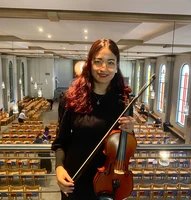
Melisa Akdag
ROT 0.009
Käthe-Kümmel-Straße 1
53115 Bonn

Agrim Aggarwal
ROT 0.009
Käthe-Kümmel-Straße 1
53115 Bonn

Nada Gharbi
ROT 0.013
Käthe-Kümmel-Straße 1
53115 Bonn
Internship student

Shambhavi Dixit
ROT 0.011
Käthe-Kümmel-Straße 1
53115 Bonn
Research Assistant

Christian Gottschlich
ROT 0.010
Käthe-Kümmel-Straße 1
53115 Bonn
Nicolas Rück
ROT 0.009
Käthe-Kümmel-Straße 1
53115 Bonn
Further topics

Offers for student
Here you will find current topics for Bachelor, Master and PhD theses in our working group.

Personal Homepage
Here you learn more about my personal academic career path.

Publications
Here you will find an overview of my research publications, all listed on InspireHEP.