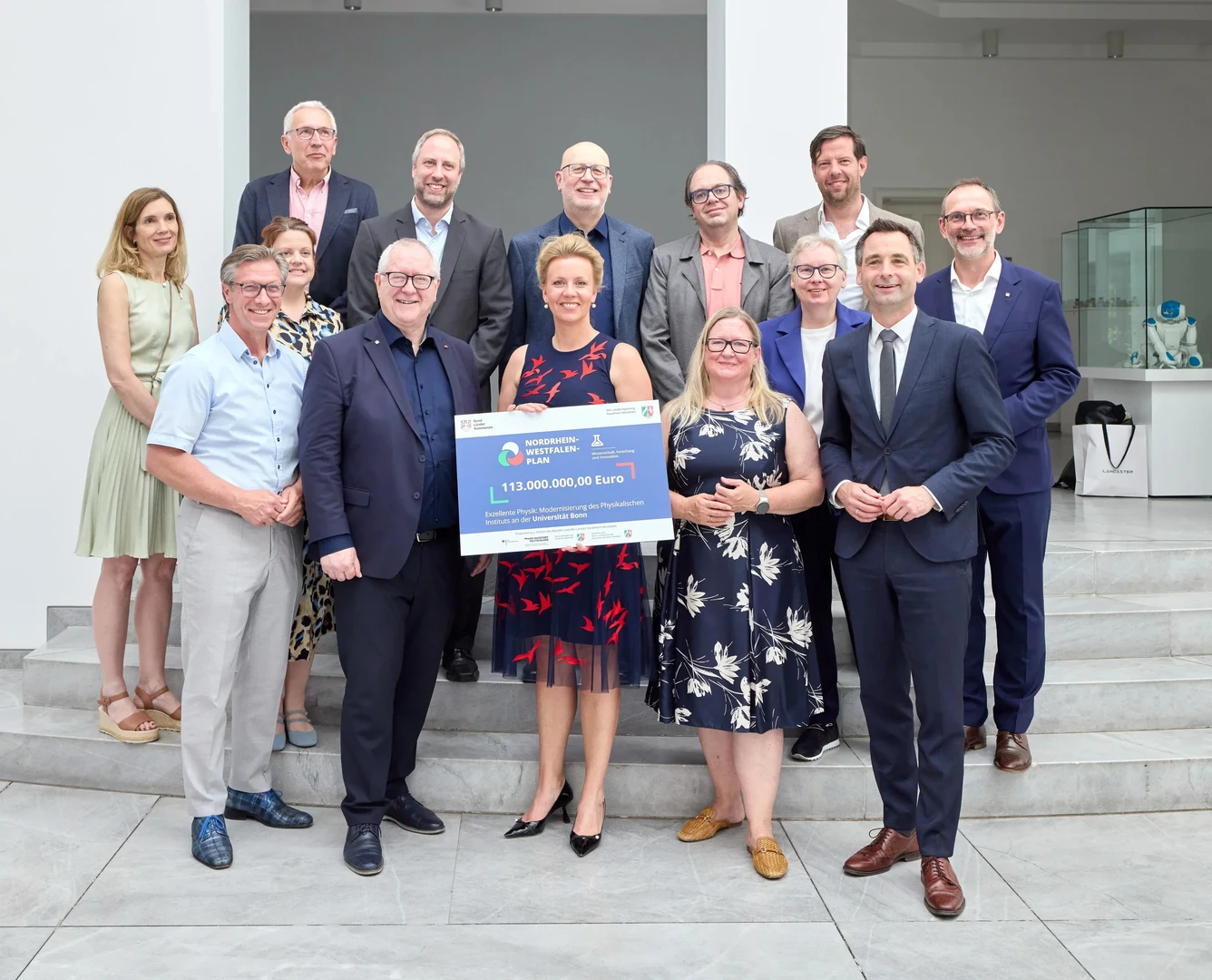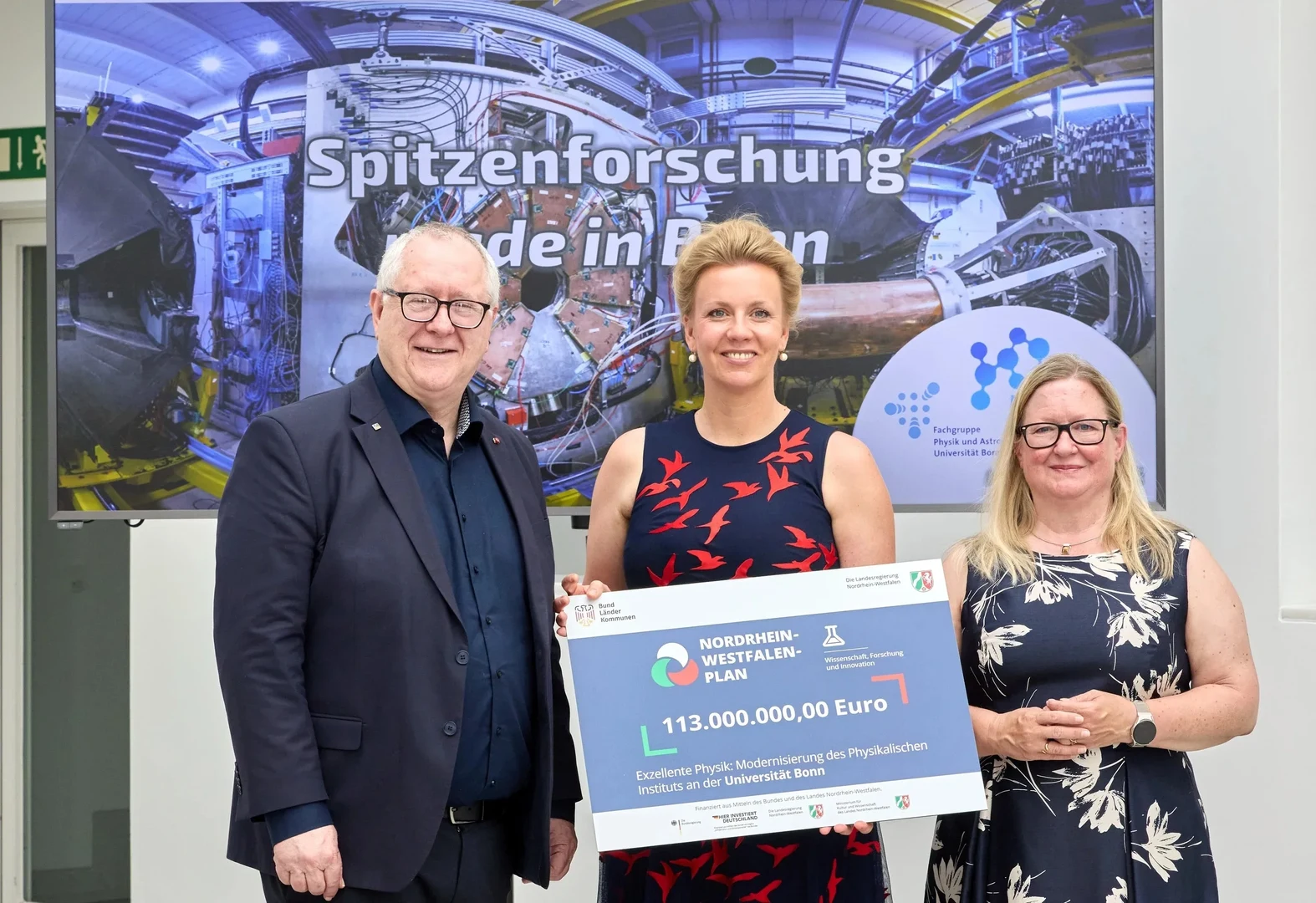
Present at the meeting in the atrium of the Rector’s Office were Rector Prof. Dr. Dr. h.c. Michael Hoch, the Chancellor’s Permanent Representative, Holger Impekoven, and representatives from the Department of Physics. With the funding commitment, the second construction phase for the modernization and partial renovation of the Physikalisches Institut on the Poppelsdorf campus is now underway. The historic building, constructed in 1913, is to be brought up to current standards both functionally and in terms of energy efficiency.
Minister of Culture and Science Ina Brandes, MdL: “Excellent research requires excellent infrastructure. Key technologies such as quantum physics and photonics provide people with, among other things, modern medical devices and the further development of quantum computers, which also enable secure data encryption. The University of Excellence Bonn and the Physikalisches Institut stand for cutting-edge research ‘made in NRW.’ This is also where the next generation of researchers is trained—researchers who are urgently needed in science and industry. With the investment from the NRW Plan, we are securing the future of physics in Bonn and will further strengthen our technological independence in Europe.”
Rector Prof. Dr. Dr. h.c. Michael Hoch said: “Physics at Bonn stands for world-class research and trains the top talent that science, industry, and society urgently need for the technologies of the future. The exceptional strength of the university is evidenced not least by three Clusters of Excellence in physics—a feat unique in Germany. With today’s commitment to comprehensively support the infrastructure needed for this, the state is making a clear and reliable commitment to excellent research and teaching. At the same time, it significantly strengthens the further development of the University of Bonn—Germany’s most successful university in the Excellence Strategy—on its path to the global forefront. For this, we thank the state government and, in particular, Minister Ina Brandes from the bottom of our hearts.”
World-Class Research and Teaching
The Department of Physics at the University of Bonn combines basic research with technological innovation, for example in detector physics, quantum technology, and data-intensive astrophysics. With the appointment of Wolfgang Paul, who would later win the Nobel Prize, Bonn has developed since the 1950s into an internationally renowned center for particle and accelerator physics. The ELSA electron stretcher facility and modern facilities such as the Research and Technology Center for Detector Physics remain central research infrastructures with international reach to this day. The Department of Physics is involved in three of Bonn’s eight Clusters of Excellence and is synonymous with internationally renowned cutting-edge research.
Modern Building Structures
Due to its large scale, the project was divided into two construction phases. The first phase involves the renovation of the ELSA test hall and the office area, as well as the modernization of central technical systems. The second phase will address the remaining historic building sections and the construction of new laboratory and workshop spaces in the inner courtyard. A key component of the concept is the targeted demolition of structural elements from the 1960s that no longer meet today’s requirements for research and teaching. In their place, a modern laboratory and workshop building will be constructed that meets the latest technical standards while offering flexible usage options for future developments.
North Rhine-Westphalia Plan
The North Rhine-Westphalia Plan for Good Infrastructure involves state-wide investments totaling approximately 31.2 billion euros over twelve years. The program’s goal is to reduce investment backlogs, modernize infrastructure, and implement key projects more quickly.